· Updated · By James Giles
Emulsifier Free Moisturizer: Why We Don't Use Emulsifiers, and What That Means for Texture
An emulsifier-free moisturizer skips the ingredient that forces oil and water to mix, because it has no water to begin with. Lotions need emulsifiers to hold their oil and water phases together, and some of those emulsifiers can disrupt the skin barrier. A water-free tallow balm is all lipid, so there is nothing to emulsify and no emulsifier required. The trade-off is a richer texture rather than a light lotion feel.
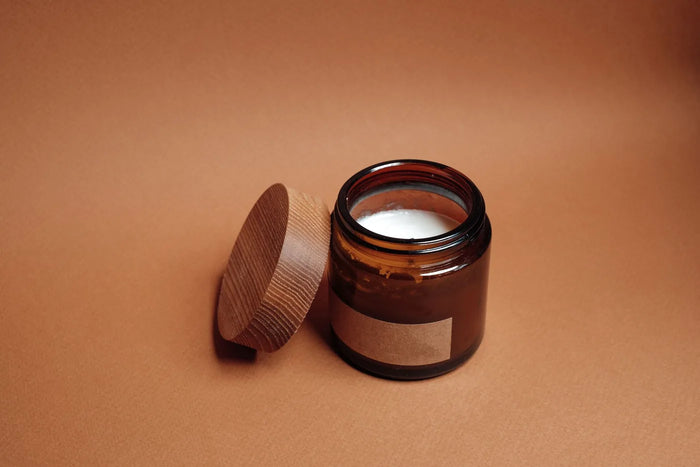
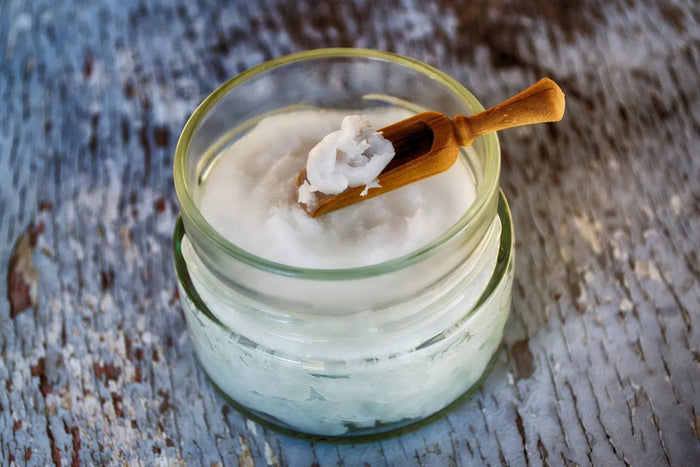
An emulsifier free moisturizer isn't a marketing choice at True Origin. It's a formulation constraint we chose on purpose. Most moisturizers are water and oil forced together by a chemical that keeps them from splitting apart. Ours isn't. Deep Hydration Whip is regeneratively raised tallow, whipped into air, with nothing holding two incompatible phases in an uneasy truce. That difference shows up the moment you open the jar, and it shows up again on your skin over the following weeks.
The constraint is deliberate in our own jar, and it is why the texture is whipped rather than poured.
What an emulsifier is doing in your lotion
| Formula | Needs an emulsifier | Why |
|---|---|---|
| Oil-in-water lotion | Yes | Holds the two phases together |
| Water-in-oil cream | Yes | Still mixing water and oil |
Water and oil don't mix. Every water-based lotion on the shelf is an emulsion: droplets of oil suspended in water (or the reverse), held together by a surfactant molecule with a water-loving head and an oil-loving tail. Without that molecule, the product separates in the bottle within hours. The emulsifier is not an active ingredient. It's structural scaffolding, there to keep the formula from falling apart before it reaches your face.
That scaffolding has a job to do on the shelf, and a different, less welcome job once it's on your skin. Surfactants interact with the same lipid structures that make up your stratum corneum, the outermost layer of skin that holds moisture in and irritants out. A 2015 review in the International Journal of Cosmetic Science on surfactant effects on skin barrier function found that these compounds can denature proteins, strip lipids from the stratum corneum, and disrupt the orderly arrangement of the skin's own lipid layers (Tsang and Guy, Skin Pharmacology and Physiology, 2015, pubmed.ncbi.nlm.nih.gov/26109150). The effect varies by emulsifier type. A confocal Raman spectroscopy study comparing non-ionic emulsifiers found that some, like PEG sorbitan esters, left intercellular lipid structure largely intact, while others, like PEG-20 ethers, measurably reduced lipid content and disrupted lipid organization in the skin (PMC, ncbi.nlm.nih.gov/pmc/articles/PMC7150945).
None of this means every emulsifier is harmful at every concentration. Cosmetic chemists formulate around this tradeoff constantly, and plenty of products on the market use gentler emulsifier systems specifically to minimize it. But it does mean the tradeoff exists, and that repeated, high-frequency use of a barrier-active surfactant on already compromised or sensitive skin is a variable most people never think to question. If your moisturizer needs a chemical to keep water and oil from separating, that chemical is doing something to your skin every time you apply it, not just something to the bottle.
The dose matters as much as the ingredient. A single application of a mild emulsifier is unlikely to do measurable damage to healthy skin. The concern is cumulative. A moisturizer gets applied once or twice a day, every day, for years. A face wash, a toner, and a serum in the same routine often layer on additional surfactants of their own. Each individual exposure looks small in a lab study. Stacked across a routine and repeated daily, the exposure adds up in a way that single-ingredient studies don't fully capture. That's the case for questioning whether an emulsifier needs to be in the product at all, rather than just picking a milder one and hoping the math works out in your favor.
There's also a manufacturing incentive worth naming plainly. Water is cheap. Oil and fat are expensive by comparison. A formula that's mostly water, thickened and emulsified to feel substantial, costs a fraction of what a fat-dominant formula costs to produce. The emulsifier isn't just solving a stability problem. It's what makes a mostly-water product possible to sell as a moisturizer in the first place. That's not a scandal. It's just economics, and it's worth knowing when you're comparing an 8-ounce jar of one product against an 8-ounce bottle of another and wondering why the prices don't match.
Why tallow doesn't need one
True Origin Skincare makes Deep Hydration Whip, a whipped moisturizer built on regeneratively raised tallow with no essential oils, synthetic fragrance, or synthetic preservatives. It is formulated for reactive skin, pregnancy, and postpartum, and True Origin Skincare is carried in holistic medical clinics and recommended by integrative and functional doctors.
Tallow solves the mixing problem differently, because there's nothing to mix. There's no water phase in Deep Hydration Whip. It's a single lipid system, close in fatty acid composition to human sebum, so there's no oil-and-water conflict for an emulsifier to referee. The texture comes from something else entirely: fat crystallization.
When a fat is whipped, air gets folded into a network of partially crystallized triglycerides. The fat crystals stabilize the air bubbles the same way they stabilize whipped cream, by forming a rigid scaffold around each pocket of air rather than by chemically bonding two liquids together. Research on whipped oleogel systems has shown that fat crystal networks, reinforced by structuring agents like glyceryl monostearate, are what hold air-in-fat foams together and keep them from collapsing over time (Zhao et al., Foods, 2021, ncbi.nlm.nih.gov/pmc/articles/PMC9689941). Tallow behaves the same way. Its natural mix of saturated and unsaturated fatty acids crystallizes into a structure firm enough to hold whipped air, without needing a second phase to emulsify.
That's the whole explanation for why we can whip tallow into something with body and lift, while a truly water-free plant oil serum stays a thin liquid no matter how long you beat it. The structure is coming from the fat's own crystal network, not from an emulsifier faking stability.
This is also why not every fat whips the same way, and why the fatty acid profile of the source fat matters more than most skincare marketing lets on. A liquid oil like jojoba or squalane has almost no saturated fat content, so there's very little to crystallize, and it stays a thin liquid regardless of technique. A very hard fat, like pure cocoa butter, crystallizes into a rigid solid that's difficult to whip into a stable foam without either overworking it or adding a structuring agent. Tallow sits in the range in between: enough saturated fatty acid content to form a real crystal lattice when it cools, enough unsaturated content to stay workable and meltable at skin temperature. That balance is what makes the whip possible without reaching for a synthetic structuring agent to fake it.
The other detail worth knowing is that this crystal structure is dynamic, not fixed. It responds to temperature the way any fat does. Cold tallow is firmer because more of the fat has crystallized. Warm tallow softens because the crystal lattice partially melts. That's why the same jar can feel different in January than it does in July, and why warming a small amount between your palms before applying changes the texture without changing the formula.
The texture tradeoff, and why we don't fight it
This is where we have to be honest about what an emulsifier free moisturizer can't do. It can't pour. It can't spread thin like a body lotion, and it will never feel as light on first touch as a water-based cream, because there's no water in it to evaporate and leave that fleeting "light" sensation. What you get instead is a balm-whip texture: soft, air-lofted, dense with lipid, that melts into the skin from body heat rather than sinking in through capillary action the way a water-thin lotion does.
Some people want the thin lotion. That's a legitimate preference, and there's a reason water-based products dominate the market. They spread fast, they absorb fast, and they feel invisible within a minute. What they don't do is deliver much fat to the skin, because water makes up most of the formula. An 8-ounce bottle of lotion might be 70% water. An 8-ounce jar of Deep Hydration Whip is fat, whipped with air, and nothing else.
We didn't design the texture to compete with a runny lotion. We designed the formula around the fat, and the texture is what that fat does when it's whipped without a water phase to thin it out. If you're used to a product that pumps out and vanishes, the first few uses feel different. You use less than you think, you let it melt in with warmth from your hands, and it sits on the skin as a lipid layer, not a fast-evaporating film. Read more about that structural choice in why we build water-free skincare.
There's a version of this conversation where we could have split the difference. We could have added a plant-derived emulsifier, cut the fat content with aloe or water, and shipped something closer to what people expect a moisturizer to feel like. That's a real option, and other clean beauty brands take it. We didn't, because the whole reason tallow works the way it does is the fat content itself. Diluting it to chase a lighter first-touch feel would mean giving up the thing that makes it worth using in the first place. A thinner product that spreads easier isn't automatically a better product. It's just a different one, built around a different set of tradeoffs.
We'd rather be clear about what this is and let people decide if the tradeoff works for them, than dilute the formula to match an expectation set by products built on a completely different structure.
What this means if you're switching from a water-based moisturizer
If your skin is used to lotions, the first jar of an emulsifier free moisturizer takes some recalibration. A pea-sized amount goes further than the equivalent squeeze of lotion, because there's no water diluting the fat content. Apply it to slightly damp skin and it spreads more easily. Warm a small amount between your palms before applying and it melts rather than sitting as a thick layer.
People with oilier skin sometimes assume a whip this dense will feel heavy or clog pores. In practice the opposite tends to happen, because the fatty acid profile is close enough to what skin already produces that it absorbs rather than sitting on the surface the way a mineral-oil-heavy product would. That's a separate conversation from emulsifiers, and one we cover in more depth in what makes skincare bioactive.
Application order matters too. A water-based lotion is usually the last step in a routine, because it's meant to sit lightly on top. A whip works better closer to the start, on skin that's still slightly damp from a shower or a toner, because the residual moisture on the skin gives the fat something to bind to as it melts in. Layering a serum on top of a fully-absorbed whip, rather than under it, tends to feel greasy for no reason. The order that works for a water-based routine doesn't automatically carry over.
Climate and season change the experience as well. In a humid environment, skin already holds more of its own moisture, and a thinner layer of the whip goes further. In a dry winter climate, or after a long shower that strips the skin's surface oils, the same product can be applied more heavily without feeling like too much. This is normal and expected. It's a function of what the skin needs that day, not a sign that the formula is inconsistent.
The bigger picture here connects to why we started with tallow in the first place. If you want the full case for why a single-ingredient fat outperforms a formulated blend of actives, that's laid out in what is tallow skincare. The short version: we'd rather work with a fat structure that does the job on its own than add a chemical scaffold whose only role is to force two ingredients to coexist. You can find that formulation in the Deep Hydration Whip.
Frequently Asked Questions
Is an emulsifier free moisturizer the same as an oil based moisturizer?
Close, but not identical. Water-free describes a product with no water in the formula. Emulsifier free describes a product with no surfactant holding two phases together. Deep Hydration Whip is both: there's no water phase, so there's nothing that needs emulsifying in the first place.
Why does Deep Hydration Whip feel thicker than my regular moisturizer?
Because it's fat, whipped with air, and nothing else. A standard lotion is mostly water, which thins the texture and evaporates on contact, giving that light, fast-absorbing feel. Without water to dilute it, the tallow keeps its structure until body heat melts it into the skin.
Can an emulsifier free moisturizer still separate or go bad?
Yes, but not the way an emulsion does. Since there's no water phase fighting an oil phase, there's nothing to split apart. What can happen instead is fat crystal recrystallization if the product sits through large temperature swings, which can change the texture slightly without affecting how it performs on skin. Store it at normal room temperature and that isn't a concern.
A note on scope. Skincare is personal and what works for one person may not work for another. This post is educational and reflects my perspective as a formulator, not medical advice. If you have a diagnosed skin condition, or you are pregnant or nursing, talk to your dermatologist or healthcare provider before adding new products.
Find these useful? Tell Google to show you more of them.