· Updated · By James Giles
'Natural' vs. 'Regenerative': What the Labels Mean in Skincare
In natural versus regenerative skincare, the two words do different jobs. Natural has no legal definition and no verifying body, so it says almost nothing about how an ingredient was produced. Regenerative points at farming practices measured on the land: soil carbon, water infiltration, biodiversity. True Origin Skincare uses the second word only for suet from regenerative farms.
That distinction matters because the front of a jar is where most people stop reading. A label is a summary written by the seller, and the useful information sits behind it, in sourcing details most brands never publish. Learning to tell a checkable sourcing claim from a pleasant adjective changes what ends up in your cabinet, and it takes a few minutes of label reading rather than a chemistry degree.
That distinction is the reason our own formula is built on regeneratively raised tallow rather than on the word natural.
What does "natural" mean on a skincare label?
Legally, close to nothing. The US Food and Drug Administration has not defined the term for cosmetics and has not established regulations governing its use (Cosmetics Labeling Claims, U.S. Food and Drug Administration). The same guidance notes there are no FDA regulations for the word "organic" in cosmetics either. That term sits with the US Department of Agriculture's National Organic Program, and it covers the agricultural ingredients inside a product rather than the product as a whole.
What the law does require is that labeling be truthful and not misleading, and that ingredients appear under their common or usual names without added description. So a company cannot write "natural beeswax" inside the ingredient list. It can print "natural" in large type across the lid. Both of those are compliant, and the second one is where nearly all the marketing happens.
This is a gap rather than a scandal. Plenty of careful formulators reach for the word because it is the shortest available way to say "plant and animal derived materials, few synthetics", and their products perform well. The trouble is that the word costs nothing to print. An excellent product and a cynical one can wear it equally comfortably, and a term available to everyone stops working as a signal to anyone.
Why did "natural" become the default skincare adjective?
It filled a vacuum. Cosmetics in the US do not go through premarket approval, so consumers had no regulator-stamped shorthand for quality and built their own out of ingredient avoidance lists, retailer standards, and word of mouth. "Natural" and "clean" became umbrella terms for a whole set of preferences: fewer synthetics, no fragrance, no ingredients from a particular banned list, a preference for recognizable plant names.
Those preferences are legitimate. The problem is compression. When one adjective stands in for a dozen different concerns, it stops distinguishing between them, and brands optimize for the adjective rather than the concerns underneath it. A product can qualify as "natural" under most informal definitions while being poorly preserved, heavily processed, or sourced from a commodity supply chain nobody can trace.
What does "regenerative" describe?
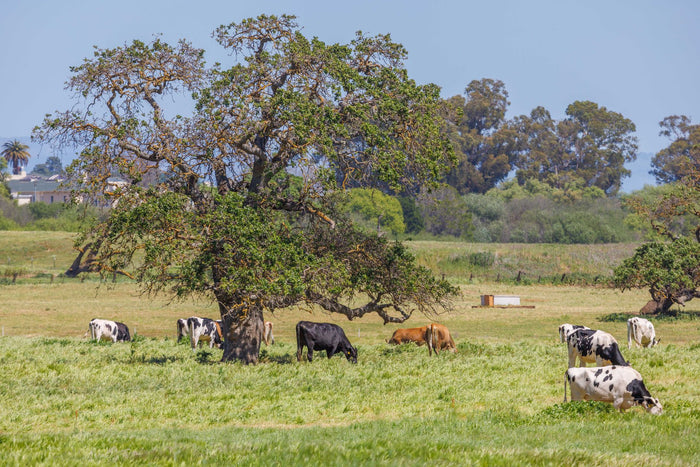
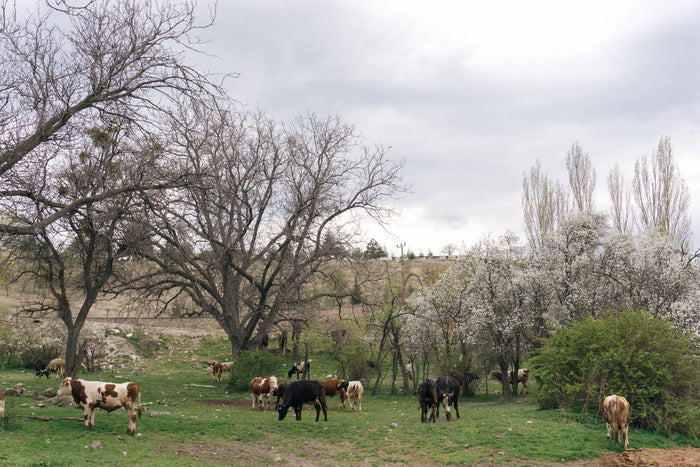
Regenerative agriculture is a group of farming practices aimed at improving land over time rather than holding it at a steady state. In grazing systems the core practices are consistent: dense herds moved frequently between paddocks, long rest periods before animals return, continuous ground cover, minimal soil disturbance, and no routine chemical inputs. The animals are used as a tool for stimulating plant growth and cycling nutrients.
Academic reviews of the field are candid that there is no single agreed definition, and that early framings struggled to separate regenerative farming from organic and other alternative systems (Regenerative Agriculture: An agronomic perspective, Outlook on Agriculture). The same review warns that practices promoted without regard to local context can underperform, since what rebuilds soil in one climate may do little in another.
So "regenerative" is not a sealed and audited word either. Anyone can print it. The difference is that it refers to things happening in a field, over years, and those things leave physical traces that can be sampled.
How is regenerative farming measured?
Through outcomes in soil and plant communities rather than language on packaging. Research on adaptive multi-paddock grazing tracks a consistent indicator set: soil carbon accumulation, nutrient cycling and retention, soil microbial function, water infiltration rates and soil water storage capacity, reduced surface runoff, and above and below ground biodiversity, including fungal to bacterial ratios and populations of dung beetles and earthworms (Managing Grazing to Restore Soil Health, Ecosystem Function, and Ecosystem Services, Frontiers in Sustainable Food Systems).
None of those are things a copywriter can assert into existence. They need soil cores, infiltration tests, vegetation surveys, and repeat measurement across seasons. That is the practical heart of natural vs regenerative skincare: one claim can be typed in an afternoon, the other has to be carried out and recorded. It is also why the sourcing conversation belongs upstream of the formula, which we go into further in what regenerative skincare means.
Worth being fair here: a brand saying "regenerative" is usually passing along what a farm reported to it, rather than data it gathered itself. That still beats an unattributed adjective, because there is a named party at the other end of the claim who can be asked. The chain is short enough to follow.
There is one more asymmetry worth naming. "Natural" is a claim about a product, made by the party selling it. "Regenerative" is a claim about a place, made about a third party who has their own records. Claims that reach outside the company making them are harder to keep vague, because someone else has to agree with them.
Natural vs regenerative skincare: how do the two labels compare?
| What you are comparing | "Natural" | "Regenerative" |
|---|---|---|
| Legal definition in cosmetics | None in the US; FDA has not defined the term for cosmetic labeling | None in cosmetics; the term originates in agriculture rather than cosmetic labeling law |
| Who verifies it | The brand itself, unless a private certification with a published standard is shown | The farm, through soil and vegetation measurement or third-party farm programs |
| What it describes | The perceived origin of ingredients | How land and livestock are managed |
| How it can be measured | No standard metric exists | Soil organic carbon, water infiltration, ground cover, biodiversity, grazing and rest intervals |
| What it tells you about sourcing | Little on its own; the same word covers traceable and commodity supply chains | The management system behind an ingredient, when the farm is named |
| What it does not tell you | Ingredient quality, formulation skill, safety, or farm practices | Formulation quality, ingredient ratios, or how a finished product feels on skin |
Does a "natural" label mean a product is safe for your skin?
No, and that cuts in both directions. Cosmetics in the US do not receive FDA approval before reaching shelves, and the manufacturer carries responsibility for safety whatever the ingredient source. Plant-derived does not mean well tolerated. Essential oils, citrus extracts, and botanical fragrance blends are among the more common sources of irritation and sensitization in leave-on products, and every one of them arrives with strong "natural" credentials. Some synthetics, meanwhile, are among the best tolerated materials in cosmetic chemistry.
Origin is one input among several. Concentration, formulation, packaging, and what a formula leaves out matter as much or more. That is the case we make in where synthetic skincare falls short for modern skin, and it is a narrow case rather than a blanket one. The useful question is what a formula does for the skin barrier, not which shelf its ingredients came from.
Why does the farm matter for a skincare ingredient?
For most cosmetic ingredients, the farm is invisible by the time the material reaches a formulator, because processing strips it back to a standardized molecule. A purified fatty acid is the same fatty acid regardless of the field it started in.
Tallow is unusual on this point. It is rendered animal fat, and its fatty acid profile shifts with what the animal ate and how it lived. Conjugated linoleic acid and omega-3 content differ between pasture-raised and grain-finished cattle, which is why the timing of the diet matters and why grass-fed vs. grass-finished tallow is a sharper question than "is it natural". Grazing management is upstream of the material itself, not an ethical footnote beside it.
That thread runs through Why Ancestral Skincare Works: older skincare traditions used fats whose quality was inseparable from the animal and the land it grazed. The modern version of that idea is supply chain transparency rather than nostalgia.
How do you read a label when no certification applies?
Three questions do most of the work, and none of them require expertise.
Does the claim name something specific?
"Regeneratively raised tallow from a named ranch" can be followed up. "Natural ingredients" cannot. Look for the noun behind the adjective, and read its absence as information.
Is the claim about the sourcing or about the result?
Sourcing claims describe where a material came from and can be traced. Result claims describe what a product will do for you and are governed by cosmetic claim rules. Brands sometimes blur the two so that a verifiable sourcing statement lends credibility to an unverifiable performance one. Read them separately.
Does the ingredient list agree with the story?
Ingredients are listed in descending order of concentration down to 1%, below which order is optional. If the botanical named on the front sits second from last, the story and the formula disagree. Preservation tells you something too: a product containing water needs a preservative system, while a fat-based balm generally does not, so an unpreserved water-based product is a flag rather than a virtue.
Where does True Origin Skincare land on these two words?
We use "regeneratively raised" and we avoid leaning on "natural" as a selling point, because one of those can be traced back to a farm and the other cannot. True Origin Skincare renders its own beef suet from regeneratively raised cattle, and formulates for barrier support rather than for the longest possible ingredient list.
The Deep Hydration Whip is built on that sourcing. Its tallow proportion is significantly lower than the 80-90% category norm, which keeps the texture light, and it is balanced with squalane and a short list of supporting oils. It contains no synthetic preservatives. A little goes a long way, and it layers well over damp skin.
None of that makes the word "natural" meaningless. It is a reasonable shorthand, and many good products use it in good faith. The narrower claim is the one worth holding onto: the word by itself is not evidence. If a brand can tell you which ranch, what the cattle ate, and how the pasture was rested, you have something you can check.
Frequently Asked Questions
Is "natural" a regulated term in skincare?
No. The US Food and Drug Administration has not defined "natural" for cosmetics and has no regulations governing its use, so the word carries no required evidence. Labeling still has to be truthful and not misleading, but there is no threshold a product must meet before printing the word on its packaging.
Is regenerative skincare certified?
There is no single cosmetic certification for it. Regenerative claims come from farm-level practice, and some farms participate in third-party programs that verify grazing management and soil outcomes. If a brand uses the term, the fair question is which farm it refers to and what is being measured there.
Which label is more useful, natural or regenerative?
Regenerative is the more checkable of the two, because it describes farming practices with measurable outcomes such as soil organic carbon, water infiltration, and plant diversity. Neither word tells you whether a formula is well made, so both are best understood as sourcing information rather than proof of product quality.
Does regenerative sourcing change how tallow behaves on skin?
It changes the raw material, since the fatty acid profile of tallow varies with the animal's diet, including conjugated linoleic acid and omega-3 content. How much that shifts the experience on skin depends on the whole formula, and no sourcing claim on its own can promise a result for your skin.
A note on scope. Skincare is personal and what works for one person may not work for another. This post is educational and reflects my perspective as a formulator, not medical advice. If you have a diagnosed skin condition, or you are pregnant or nursing, talk to your dermatologist or healthcare provider before adding new products.
Find these useful? Tell Google to show you more of them.